Why a Deep Window Sill Becomes Part of the Room
A deep window sill can connect a country room to its garden. Use this practical check to choose what belongs there and keep daily tasks easy.
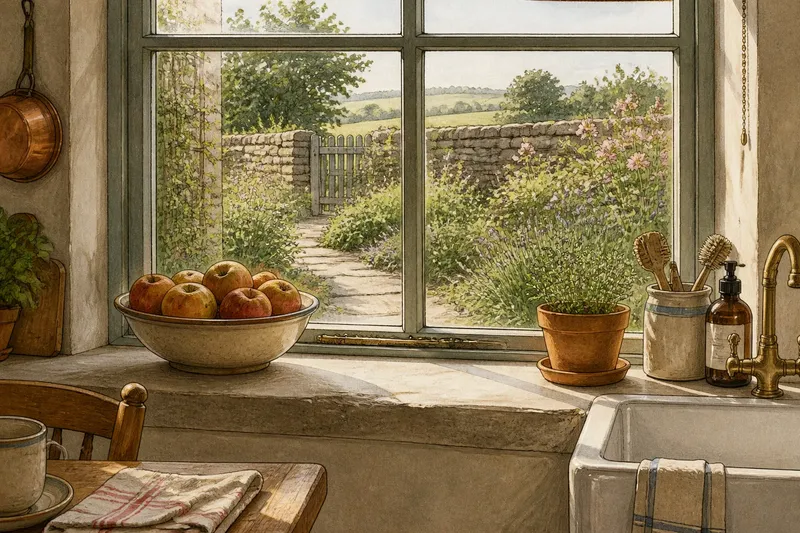
A bowl of apples sits beside the kitchen window while rain blurs the herb patch outside. The deep window sill is not quite a table and not quite part of the view; it is where breakfast, washing-up and the garden meet.
To make that space useful, start with what you do near the window and what you want to see through it. A few deliberate choices can keep the sill practical without turning it into a shelf for things that have nowhere else to go.
What should a deep window sill do?
Decide whether the sill is mainly a working surface, a place to display one or two things, or a clear edge that keeps the garden in view. It can do more than one job, but naming the main one makes it easier to decide what stays.
Think of it like a kitchen tray: a boundary helps keep useful things together, but anything without a clear purpose soon makes the surface harder to use. A fruit bowl might earn its place if someone reaches for it at breakfast. Keys or parcels may be better near the door.
How do you check the sill before arranging it?
Take everything off the ledge, then look through the window from the places you actually use: the kitchen chair, the sink and the doorway. Notice which parts of the garden disappear behind objects and whether the sill is comfortable to reach. Then use this checklist; each observation points to a decision.
- View from the table: If an object hides a garden detail you like seeing, move it to another surface; if it leaves the view open, keep it under consideration.
- View from the sink: If you cannot see the path, hedge or planting you want to notice, lower or remove the obstructing item; otherwise, leave the view as it is.
- Reach from your usual position: If you have to stretch or lean over a hot hob or sink to use an item, relocate it; if it is easy to reach safely, it can serve a daily task.
- Water marks or condensation: If the sill or objects become damp, remove vulnerable items and check the window area; if the surface stays dry, choose objects suited to ordinary use.
- Light on the ledge: If glare or strong sun makes the surface uncomfortable or affects an item, move that item or leave the area clear; if the light is pleasant and manageable, it can remain part of the arrangement.
- Items with no regular job: If something is only there because it was set down in passing, return it to a proper home; if you use it beside the window, keep it within reach.
- Clear space for a task: If there is no room to set down a cup or wipe the sill, remove a decorative object; if the surface remains usable, keep the arrangement.
Do not treat every item as a decoration problem. A damp cloth may need to dry elsewhere, while a herb pot may need a position suited to its care instructions and the window’s conditions. Check product guidance where an item has specific placement or safety requirements.
Which choices suit the view and the routine?
Let the outdoor view suggest a connection, not a matching scheme. A small terracotta pot might pick up the colour of a garden path; a plain bowl can sit quietly against a busy view of leaves and flowers. If the outlook is mostly a wall or working yard, a useful object nearby may give the eye a closer point of interest.
Choose the object for the task as well as its appearance. A shallow dish can hold fruit without taking over the ledge. A folded cloth may be handy near a sink, provided it has room to dry. If an item blocks the view or makes cleaning awkward, it is not earning its place there.
What should you ask before keeping an item there?
Should a deep window sill be left empty?
Yes, if the view is what you most want to notice or the room feels crowded. Clear the ledge and see whether the window is easier to use and the garden easier to see.
What can go on a deep window sill?
Choose a few things with a clear purpose, such as a fruit dish or a suitable small plant. Check that they do not obstruct the view, create a cleaning nuisance or conflict with care instructions.
How do I know if something blocks the view?
Look through the window from the chair, sink and doorway rather than judging it from directly in front. If an object covers a detail you want to see from those positions, move it or choose a lower item.
How often should I reconsider the arrangement?
Recheck it when your routine or the view changes, such as when you begin using the sill for a different task. If the arrangement still works from your usual places, there is no need to alter it.
How might a small change work in practice?
Say you have a deep kitchen sill with a fruit bowl, a thyme pot, a stack of post and a pair of gloves left after tending the garden. From your chair, the post hides the herb patch; at the sink, the gloves make it awkward to wipe the surface. First, move the post to its usual sorting place and put the gloves where they can dry. Next, check the view and reach again. If the bowl and thyme remain easy to use and do not block the view, keep them; if the pot still hides the path, shift it to the side or choose a lower pot. The resulting arrangement keeps the breakfast fruit handy while restoring a clear view of the patch, with the trade-off that the sill has less spare space for temporary items.
A deep window sill works best when its contents answer to the room’s real habits. Use the checklist again when you change the arrangement, and make the same decision from the places where you sit, stand and work. That keeps the window useful without asking it to hold every passing object.