Before the Printed Almanac: Keeping the Year in Mind
Explore how household calendars before the printed almanac used feast days, local signs and recurring work to prompt decisions without fixing every date.
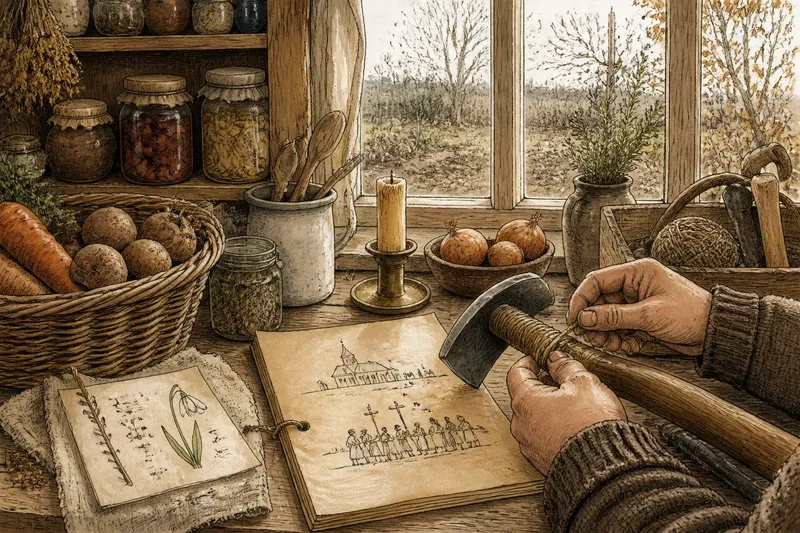
In a late-autumn household, someone might be checking stored food while another mends a tool and keeps an approaching feast day in mind. A household calendar before the printed almanac was not necessarily a book: it could combine spoken reminders, repeated work and local observance. The details varied by community, so these customs are best understood as practical ways of remembering rather than one uniform system.
What did a household calendar hold?
For households whose work followed the seasons, a year could be recalled through tasks that returned: tending animals, preparing ground, gathering crops, preserving food and repairing equipment. The order mattered, even when no one wrote it into a dated schedule.
Reminders might be spoken, attached to an object, or written where they could be seen. A household could use several forms at once. Think of them as different compartments in a kitchen drawer: each keeps a useful thing close, but none holds everything.
There was no single arrangement shared by every place or household. Work depended on local conditions and responsibilities; religious observances depended on the community. That variety makes it safer to ask what a particular reminder helped someone remember than to assume every household kept the year in the same way.
How did feast days mark time?
In Christian communities, recurring festivals and saints’ days provided shared points in the year. People could refer to a task or gathering in relation to an observance familiar to their neighbours. The day might also shape customary pauses or preparations, depending on local practice.
A feast day offered a social marker, not a complete work schedule. It could not say whether a particular plot was ready for sowing or whether a household’s stores needed attention. The distinction is simple: an observance helped people name a point in a shared calendar, while the condition of the work still called for local judgement.
What did seasonal signs tell people?
People could pay attention to familiar changes nearby: the state of the ground, the length of daylight, or signs in plants and animals. Such observations might prompt someone to inspect a field or garden. They were tied to a place and a season, not a fixed date that applied everywhere.
A remembered saying could make an observation easier to recall, but it could not remove uncertainty. A sign might appear differently from one year to another, so it was a reason to look closely rather than an order to act. The land, weather and available time still mattered.
Which reminder suited which task?
Choose the kind of reminder by the decision it needs to support. A recurring routine helps recall work; a feast day gives a shared reference; a local sign prompts an inspection. The following distinctions keep those uses clear:
- Recurring work: Check whether the task returns as part of the household’s usual seasonal order. If it does, keep it in that routine; if its timing depends on changing conditions, add a local observation before acting.
- Feast day: Check whether the reminder concerns a shared observance or gathering. If it does, use the day as a common reference; if it concerns a field or garden condition, inspect that place rather than relying on the date.
- Seasonal sign: Check what is actually visible in the local setting. If the sign is present, consider the relevant task; if it is absent or unclear, wait for a clearer observation or use another reminder.
- Written note: Check whether the note names a date, a task or a condition. If it names a date, use it to remember the occasion; if it names a condition, check that condition before deciding what to do.
- Spoken reminder: Check who shares the reminder and what they mean by it. If it refers to a familiar household routine, follow that routine; if the meaning is uncertain, clarify the task instead of assuming.
- Printed almanac: Check what information the particular almanac contains. If it supplies a useful date or note, use it as a reference; if it cannot account for local conditions, inspect the work site before acting.
Say a household wants to prepare a garden bed in spring. The starting point is an invented situation: a spoken reminder says the work usually comes after a familiar feast day, while the ground is still wet when someone checks it. They keep the observance as a memory prompt, inspect the bed again later, and begin only when the ground is workable. The result is a shared reminder without treating the feast day as a fixed instruction.
What changed when almanacs were printed?
Printed almanacs gathered written information in a form readers could consult and keep. Their contents differed, but an individual almanac might bring dates, observances or practical notes together. It could provide a written reference beyond one household’s spoken routine.
Print did not replace local judgement. A page could record a date, but it could not see the condition of a particular patch of soil or identify work left unfinished. Readers still had to relate written guidance to their own circumstances.
Access and use varied, too. It would be misleading to describe every household as moving from oral custom to a printed book, or to assume that all readers owned or followed the same almanac. Spoken customs and household marks could continue alongside printed references.
How should you distinguish these kinds of calendars?
Were household calendars always written down?
No. A recurring sequence of work or a spoken reminder could help people remember the year without a written record. Written marks and books were possible tools, not a requirement.
Did feast days set the exact time for farm work?
They could provide a shared point of reference, but they did not account for the condition of every field or garden. Local circumstances still shaped the decision.
Could seasonal signs replace a calendar?
They could prompt observation of nearby conditions, but they did not record every date or duty. Their usefulness lay in helping someone decide what to inspect, not in prescribing a complete schedule.
What is the difference between a feast day and a seasonal sign?
A feast day was a recurring communal marker, while a seasonal sign was something observed in a particular place. One helped people refer to shared time; the other prompted attention to local conditions.
How can you read this history without treating it as a rulebook?
Separate the reminder from the decision it prompted. A feast day named a shared point in time; a seasonal sign described something noticed nearby; a household routine recalled work that came round again. Keeping those categories distinct avoids turning varied customs into universal instructions.
The phrase household calendar before the printed almanac points to more than one way of keeping the year in mind. When you encounter a historical custom, ask what it helped someone remember and what still required judgement. That question makes room for local variation—and for the practical difference between knowing a task is due and deciding whether conditions are right for it.